
VolImpact
The Research Unit (Forschungsgruppe) VolImpact (FOR 2820) was funded by the Deutsche Forschungsgemeinschaft (DFG) for a period of two times three years and dealt with different important aspects of volcanic impacts on the atmosphere and climate. The funding period started in 2019 and most of the projects ended in 2025 or at the beginning of 2026. VolImpact was coordinated by the Institute of Physics of the University of Greifswald. The other participating institutions were the Institute of Environmental Physics at the University of Bremen, the Institutes of Meteorology at the Universities of Hamburg and Leipzig, the Max-Planck-Institute of Meteorology in Hamburg, the German Climate Computing Center as well as the Institute of Meteorology and Climate Research at the Karlsruhe Institute of Technology. Scientific work within VolImpact was carried out in five science projects, namely VolPlume, VolARC, VolCloud, VolDyn and VolClim. The following paragraphs summarize some of the key findings of these projects.


VolPlume
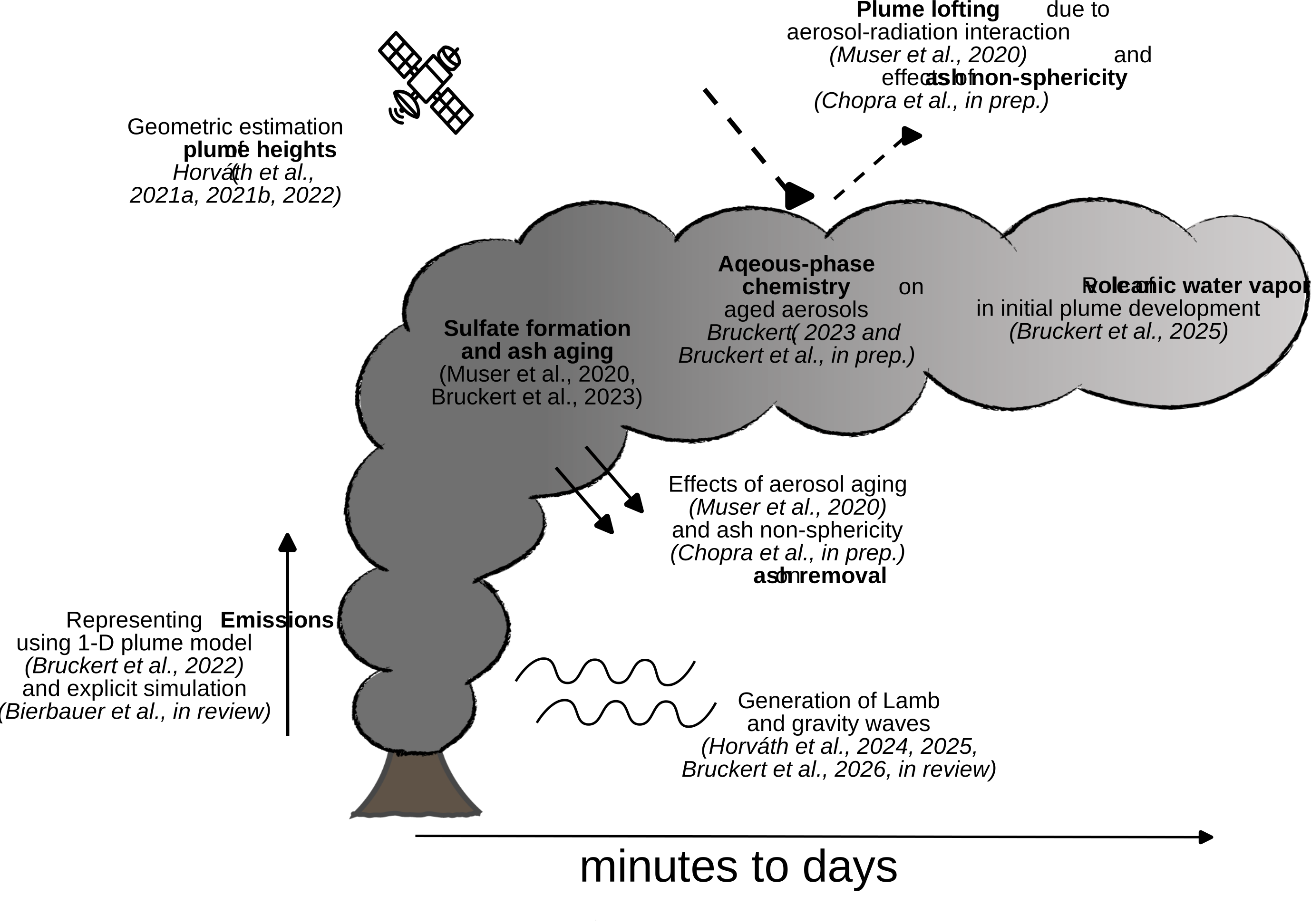
This project advanced the modelling and observation of volcanic plumes across two phases, integrating chemistry, microphysics, plume dynamics, and satellite retrieval. Phase 1 established an improved, physically consistent representation of volcanic emissions and developed geometric satellite techniques for plume-height estimation. Phase 2 was reshaped by the exceptional 2022 Hunga eruption, which became a central case study and drove the integration of previously separate work packages into a single comprehensive modelling and observational framework. Main findings and outcomes are depicted in Figure 1 and otlined below:
- Coupled emission modelling. FPlume was fully coupled with ICON-ART, replacing the earlier empirical mass-eruption-rate assumption with an online, physically consistent calculation that also captures distinct eruption phases. The coupled system was validated on the 2019 Raikoke and 2021 La Soufrière eruptions and is now part of the open-source ICON-ART code for scientific and operational use.
- Aerosol aging and chemistry. Ash aging in ICON-ART was validated against MISR observations, with the aged-ash fraction increasing with distance from the vent and being higher in the troposphere. Aqueous-phase chemistry proved marginal for SO₂ oxidation in the high-altitude Raikoke plume but significant in lower, water-rich plumes.
- The Hunga eruption as a testbed. Seven-day plume simulations showed that large water-vapour emissions enhance sulfate formation and prolong ash aging, suggesting some satellite-detected sulfate may be misclassified aged ash. Companion LES runs reproduced plume rise, umbrella-cloud spreading, and Lamb/gravity waves, and revealed a volcanic mesocyclone.
- Integrated framework. Two efforts were merged into one framework representing dynamics, microphysics, aerosol processes, aqueous-phase chemistry, and iron dissolution simultaneously, applied to the Eyjafjallajökull eruption, where enhanced SO₂ oxidation and iron dissolution (relevant to ocean biogeochemistry) were found.
- Aerosol dynamics and non-sphericity. Studies of sea-salt-driven ash removal showed Brownian coagulation can be a limiting process, motivating an enhanced coagulation kernel. Ongoing work extends non-spherical optics to volcanic ash.
- Satellite retrievals (WP3). Stereo (3D Winds) and novel single-view geometric methods (~500 m accuracy) were developed and widely applied. These established the record 55–58 km mesospheric height of the Hunga plume (Carr et al., 2022; 225 citations) and enabled Lamb-wave studies, including its effect on cloud reflectance ~12,000 km away, earning Editor's Highlight and Nature Research Highlight recognition.
Hoshyaripour, G. A., Baer, A., Bierbauer, S., Bruckert, J., Brunner, D., Förstner, J., Hamzehloo, A., Hanft, V., Keller, C., Klose, M., Kumar, P., Ludwig, P., Metzner, E., Muth, L., Pauling, A., Porz, N., Ramezani Ziarani, M., Reddmann, T., Reißig, L., Ruhnke, R., Satitkovitchai, K., Seifert, A., Sinnhuber, M., Steiner, M., Versick, S., Vogel, H., Weimer, M., Werchner, S., and Hoose, C.: The atmospheric composition component of the ICON modeling framework: ICON-ART version 2025.10, Geosci. Model Dev., 19, 1645–1681, https://doi.org/10.5194/gmd-19-1645-2026, 2026.
Horváth, Á., Adams, D. K., Liu, M., Sepúlveda, I., Sakradzija, M., and Buehler, S. A.: Transient darkening of low-level liquid clouds by the 2022 Hunga Lamb wave observed in GOES-R imagery, Geophys. Res. Lett., 52, e2025GL115935, https://doi.org/10.1029/2025GL115935, 2025.
Bruckert, J., Chopra, S., Siddans, R., Wedler, C., and Hoshyaripour, G. A.: Aerosol dynamic processes in the Hunga plume in January 2022: does water vapor accelerate aerosol aging?, Atmos. Chem. Phys., 25, 9859–9884, https://doi.org/10.5194/acp-25-9859-2025, 2025.
Horváth, Á., Vadas, S. L., Stephan, C. C., and Buehler, S. A.: One-minute resolution GOES-R observations of Lamb and gravity waves triggered by the Hunga Tonga–Hunga Ha'apai eruptions on 15 January 2022, J. Geophys. Res. Atmos., 129, e2023JD039329, doi.org/10.1029/2023JD039329, 2024.
Bruckert, J., Hirsch, L., Horváth, Á., Kahn, R. A., Kölling, T., Muser, L. O., Timmreck, C., Vogel, H., Wallis, S., and Hoshyaripour, G. A.: Dispersion and aging of volcanic aerosols after the La Soufrière eruption in April 2021, J. Geophys. Res. Atmos., 128, e2022JD037694, doi.org/10.1029/2022JD037694, 2023.
Bruckert, J., Hoshyaripour, G. A., Horváth, Á., Muser, L., Prata, F. J., Hoose, C., and Vogel, B.: Online treatment of eruption dynamics improves the volcanic ash and SO₂ dispersion forecast: case of the 2019 Raikoke eruption, Atmos. Chem. Phys., 22, 3535–3552, https://doi.org/10.5194/acp-22-3535-2022, 2022.
Carr, J. L., Horváth, Á., Wu, D. L., and Friberg, M. D.: Stereo plume height and motion retrievals for the record-setting Hunga Tonga–Hunga Ha'apai eruption of 15 January 2022, Geophys. Res. Lett., 49, e2022GL098131, https://doi.org/10.1029/2022GL098131, 2022.
Horváth, Á., Carr, J. L., Wu, D. L., Bruckert, J., Hoshyaripour, G. A., and Buehler, S. A.: Measurement report: Plume heights of the April 2021 La Soufrière eruptions from GOES-17 side views and GOES-16–MODIS stereo views, Atmos. Chem. Phys., 22, 12311–12330, doi.org/10.5194/acp-22-12311-2022, 2022.
VolARC
VolARC contributions by the University of Greifswald
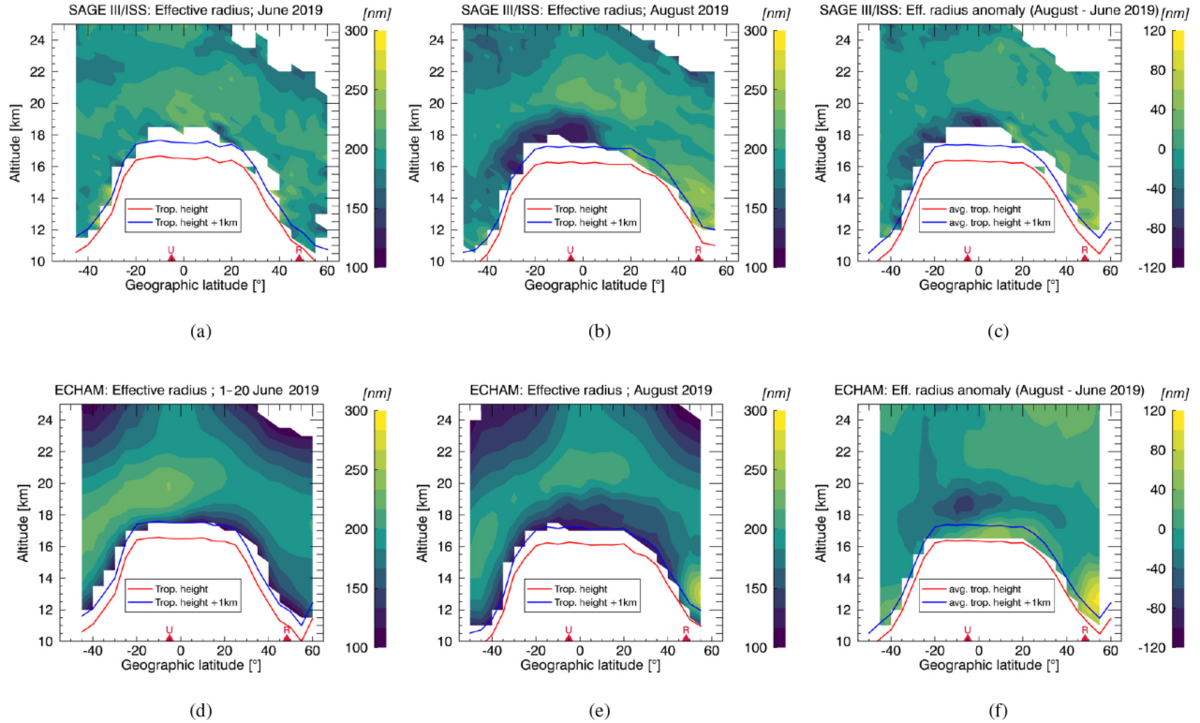
One focus of VolARC in Greifswald was to constrain the stratospheric aerosol particle size evolution after volcanic eruptions.
- A method was introduced to retrieve the stratospheric aerosol size from SAGE III/ISS satellite solar occultation measurements, that produced unambiguous retrievals of all three parameters of a monomodal lognormal distribution (Wrana et al., 2021).
- Unexpected finding: Some volcanic eruptions lead to a strong decrease in average stratospheric aerosol size, that can last for many months (Wrana et al., 2023). The retrieval data was also compared to model simulations (see below).
- Application of the new retrieval method to the SAGE III/M3M data set also characterizes the stratospheric aerosol size in close-to-background conditions. Comparisons with in situ balloon-borne measurements show good overall agreement (Wrana et al., 2025).
Another key focus was the question of the detectability of possible stratospheric aerosol injections.
The combination of MAECHAM5-HAM model data as well as simulations and retrievals using the SCIATRAN radiative transfer model demonstrated that it is possible to detect stratospheric sulfate aerosols formed from the continuous injection of 1 and 2 Tg S/y from the perspective of a typical satellite solar occultation instrument (Lange et al., 2025).
The combination of MAECHAM5-HAM model data and SCIATRAN simulations also made it possible to identify the minimum wavelengths required for a typical satellite solar occultation instrument to detect the stratospheric aerosols formed from continuous injections of 10 and 30 Tg S/y, in order to circumvent the so-called ‘zero transmission’ problem (Lange et al., 2026).
In addition, we also investigated the effect of volcanic eruptions on optical phenomena of the atmosphere and on the colours of the sky:
Volcanic eruptions can lead to unusual colours of the sun or moon. In Wullenweber et al. (2021) we simulated the occurrence of blue suns assuming volcanic sulfate aerosols in the stratosphere. If the aerosol radius is about 500 nm, then “anomalous scattering” occurs and blue suns can be simulated. Other potential physical processes were also investigated.
The Royal Society’s Krakatoa report contains numerous eyewitness reports of green sunsets (in contrast to the usual red sunsets) after the 1883 eruption of Krakatao. We were able to simulate green sunsets using radiative transfer calculations and provided a physical explanation for their occurrence for the first time (von Savigny et al., 2024).
We investigated, whether the colours in photographs of historic paintings can be used to infer quantitative information on the aerosol optical depth, particularly in the aftermath of volcanic eruptions. Because of different issues this was found to be impossible in general (von Savigny et. al., 2022).
In collaboration with art historians we identified depictions of noctilucent clouds (NLCs), also known as polar mesospheric clouds (PMCs), in sketches by British artist William Ascroft in the northern summers of 1885 and 1886 (von Savigny et al., 2026a). In addition, potential NLC depictions in summer 1884 were identified, which would be the earliest known evidence of NLCs (von Savigny et al., 2026b).
VolARC contributions by the University of Bremen
- development of the algorithm to retrieve globally the aerosol particle size distribution (PSD) parameters from SCIAMACHY limb-scatter observations
- creation of new improved aerosol extinction data sets retrieved from SCIAMACHY limb measurements:
- one wavelength retrieval (750 nm)
- extinction coefficients from retrieved particle size distributions (multi-wavelength)
- development of the new one-wavelength retrieval for the aerosol extinction coefficient form OMPS-LP limb-scatter measurements
- development of the new multi-wavelength retrieval for the aerosol extinction coefficient and particle size distribution information from OMPS-LP limb-scatter measurements
- data sets of the aerosol extinction coefficients and PSD parameters are generated and used for:
- comparison of the measurement data sets
- creation of an aerosol extinction climate data record
- comparisons with model simulations for selected volcanic eruptions, investigation of the influence of model initialization parameters
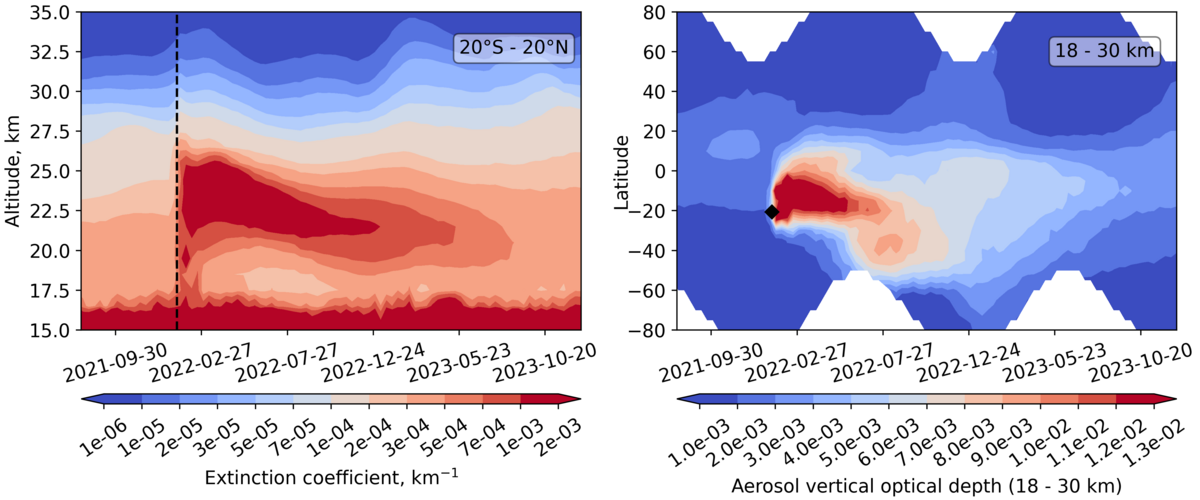
- investigation of the stratospheric aerosol loading after the Hunga-Tonga volcanic eruption
- evaluation of aerosol models and volcanic emission data sets
- investigation of the influence of the stratospheric aerosol loading on the ozone retrievals
- generation of the improved ozone time series
VolARC contributions by the Max-Planck-Institute of Meteorology
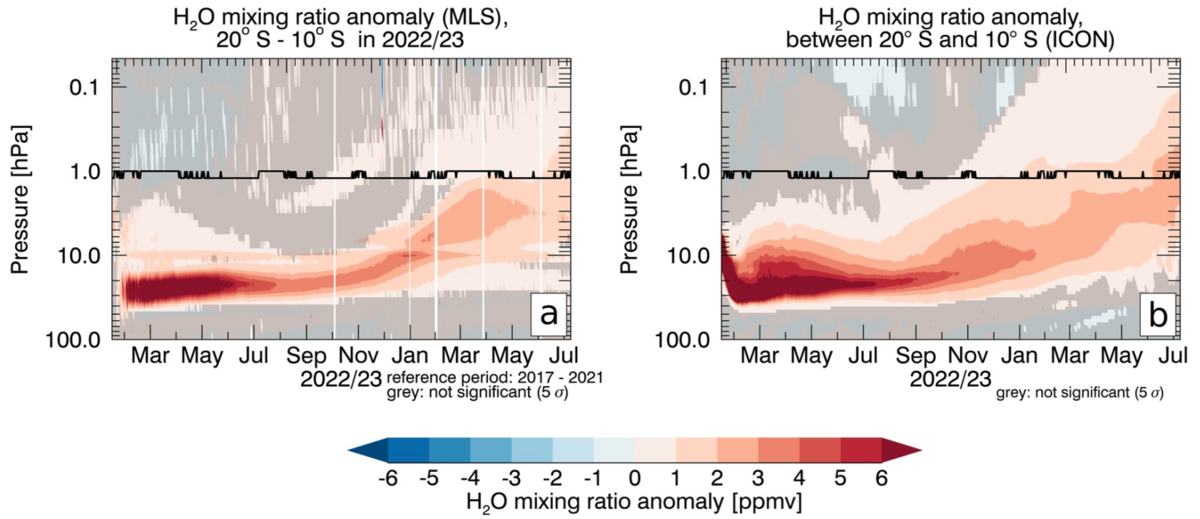
The focus of our project part was a detailed comparison of the volcanic cloud in model results and satellite observations. The intercomparison showed that:
- ECHAM-HAM results for sulfate aerosol particle size evolution agreed well with SAGE III and SCIAMACHY retrievals when good vertical profiles and injection altitudes were available and nudging was included in ECHAM to reduce the transport of tracers across the latitudinal gradient (Wrana et al., 2023; Pohl et al., 2026). A good representation of the aerosol size distribution also requires proper setting of the mode width specific to each eruption.
- ECHAM-HAM simulated the reduction in particle size following the Ulawun eruption in the tropics, which helped to shed light on related processes, such as strong nucleation due to the cold tropical stratosphere. In the model, the lifetime of the small particles was shorter than in observations as coagulation processes strengthened once a certain particle size was reached. This is the subject of an ongoing model intercomparison.
- ICON XPP simulations of the spatial evolution of the H₂O cloud closely match observations from the Aura Microwave Limb Sounder (Niemeier et al., 2023). The H₂O cloud underwent three phases of vertical transport: an initial subsidence phase, a stable phase, and a rising phase. These phases are caused by the radiative cooling of H₂O, as demonstrated using passive tracers. Many details of the water vapour cloud's transport were also simulated very well, such as parts of the cloud crossing the equator.
Chin, M., Wright, J. S., Bian, H., Tan, Q., Pan, X., Takemura, T., Matsui, H., Tsigaridis, K., Bauer, S., Ginoux, P., Peng, Y., Guo, Z., Fadnavis, S., Laakso, A., Burrows, J. P., Taha, G., Kar, J., Rozanov, A., Arosio, C., Rieger, L., and Bourassa, A.: Variability and trends of upper-tropospheric aerosols over the Asian summer monsoon region: an AeroCom multi-model study, Atmos. Chem. Phys., 26, 60356059, https://doi.org/10.5194/acp-26-6035-2026, 2026.
Duchamp, C., Legras, B., Podglajen, A., Sellitto, P., Bourassa, A. E., Rozanov, A., Taha, G., and Zawada, D. J.: Aerosol Composition and Extinction of the 2022 Hunga Plume Using CALIOP, Atmos. Meas. Tech., 19, 16751696, https://doi.org/10.5194/amt-19-1675-2026, 2026.
Lange, A., Niemeier, U., Rozanov, A., and von Savigny, C.: Investigating the ability of satellite occultation instruments to monitor possible geoengineering experiments, Atmos. Chem. Phys., 25, 11673–11688, doi.org/10.5194/acp-25-11673-2025, 2025.
Lange, A., Niemeier, U., Rozanov, A., and von Savigny, C.: Investigating the zero transmission problem in satellite solar occultation measurements in the context of possible stratospheric aerosol injections, Atmos. Meas. Tech., 19, 1973–1989, doi.org/10.5194/amt-19-1973-2026, 2026.
Malinina, E., Rozanov, A., Niemeier, U., Wallis, S., Arosio, C., Wrana, F., Timmreck, C., von Savigny, C., and Burrows, J. P.: Changes in stratospheric aerosol extinction coefficient after the 2018 Ambae eruption as seen by OMPS-LP and MAECHAM5-HAM, Atmos. Chem. Phys., 21, 14871?14891, https://doi.org/10.5194/acp-21-14871-2021, 2021.
Niemeier, U., Wallis, S., Timmreck, C., van Pham, T., & von Savigny, C. (2023). How the Hunga Tonga—Hunga Ha'apai water vapor cloud impacts its transport through the stratosphere: Dynamical and radiative effects. Geophysical Research Letters, 50, e2023GL106482. https://doi.org/10.1029/2023GL106482
Pohl, C., Niemeier, U., Rozanov, A., Wrana, F., and von Savigny, C.: Evaluating SCIAMACHY-retrieved and ECHAM-simulated stratospheric aerosol characteristics by their comparison after volcanic eruptions, EGUsphere [preprint], https://doi.org/10.5194/egusphere-2026-578, 2026.
Pohl, C., Wrana, F., Rozanov, A., Deshler, T., Malinina, E., von Savigny, C., Rieger, L. A., Bourassa, A. E., and Burrows, J. P.: Stratospheric aerosol characteristics from SCIAMACHY limb observations: two-parameter retrieval, Atmos. Meas. Tech., 17, 41534181, https://doi.org/10.5194/amt-17-4153-2024, 2024.
Rozanov, A., Pohl, C., Arosio, C., Bourassa, A., Bramstedt, K., Malinina, E., Rieger, L., and Burrows, J. P.: Retrieval of stratospheric aerosol extinction coefficients from sun-normalized Ozone Mapper and Profiler Suite Limb Profiler (OMPS-LP) measurements, Atmos. Meas. Tech., 17, 66776695, https://doi.org/10.5194/amt-17-6677-2024, 2024.
Sofieva, V. F., Rozanov, A., Szelag, M., Burrows, J. P., Retscher, C., Damadeo, R., Degenstein, D., Rieger, L. A., and Bourassa, A.: CREST: a Climate Data Record of Stratospheric Aerosols, Earth Syst. Sci. Data, 16, 52275241, https://doi.org/10.5194/essd-16-5227-2024, 2024.
Pohl, C., Niemeier, U., Rozanov, A., Wrana, F., and von Savigny, C.: Evaluating SCIAMACHY-retrieved and ECHAM-simulated stratospheric aerosol characteristics by their comparison after volcanic eruptions, EGUsphere [preprint], doi.org/10.5194/egusphere-2026-578, 2026.
von Savigny, C., Lange, A., Hemkendreis, A., Hoffmann, C. G., and Rozanov, A.: Is it possible to estimate aerosol optical depth from historic colour paintings?, Clim. Past, 18, 2345–2356, https://doi.org/10.5194/cp-18-2345-2022, Research highlight, 2022.
von Savigny, C., Lange, A., Hoffmann, C. G., and Rozanov, A.: Explaining the green volcanic sunsets after the 1883 eruption of Krakatoa, Atmos. Chem. Phys., 24, 2415–2422, Research Highlight, doi.org/10.5194/acp-24-2415-2024, 2024.
von Savigny, C., Ansel, E. and Heck, K., William Ascroft, Krakatoa and Noctilucent Clouds, Kunstchronik, 79, 8, 589 – 596, doi.org/10.11588/kc.2026.8.115896, 2026a.
von Savigny, C., S. Wallis, A. Lange, C. Hoffmann and H. Schmidt, Potential depictions of noctilucent clouds in 1884 sketches by William Ascroft, submitted to the Bulletin of the Americal Meteorological Society, 2026b.
Wrana, F., von Savigny, C., Zalach, J., and Thomason, L. W.: Retrieval of stratospheric aerosol size distribution parameters using satellite solar occultation measurements at three wavelengths, Atmos. Meas. Tech., 14, 2345–2357, doi.org/10.5194/amt-14-2345-2021, 2021.
Wrana, F., Niemeier, U., Thomason, L. W., Wallis, S., and von Savigny, C.: Stratospheric aerosol size reduction after volcanic eruptions, Atmos. Chem. Phys., 23, 9725–9743, https://doi.org/10.5194/acp-23-9725-2023, 2023.
Wullenweber, N., Lange, A., Rozanov, A., and von Savigny, C.: On the phenomenon of the blue sun, Clim. Past, 17, 969–983, https://doi.org/10.5194/cp-17-969-2021, Research highlight, 2021.
VolCloud

The role of the project VolCloud within the research unit was to quantify the response of clouds to volcanic eruptions, and the subsequent alteration of the effective radiative forcing.
We first studied how the injection of aerosols into the troposphere changes clouds, in particular via volcanic aerosols serving as cloud condensation nuclei. Haghighatnasab et al. (2022) demonstrated a clearly attributable increase in cloud drop number concentrations within the volcanic plume, consistently between satellite observations and modelling. Further changes in cloud horizontal and vertical extent were, however, not attributable, even if the liquid water path showed some discernible signal in the model simulations. We went further to also assess potential changes in mixed-phase and ice clouds using coupled aerosol-climate modelling at high resolution. Zarei et al. (2026) demonstrated from these simulations that riming is weakened due to the volcanic aerosol, resulting in smaller graupel concentration. We also analysed the response of clouds to stratospheric aerosol, via cloud adjustments to the cooling mechanims. Lange and Quaas (2025) demonstrated using available simulations from the Coupled Model Intercomparison Project that cloud adjustments offset about 1/3 of the initial forcing in the solar spectrum. Cloud responses showed a distinct land-ocean anomaly in the simulations.
Zarei, F., Bruckert, J., Hoshyaripour, G. A., and Hoose, C.: Volcanic aerosol effects on warm and cold cloud microphysics: ICON-ART simulations of Holuhraun and La Soufrière eruptions, EGUsphere [preprint], doi.org/10.5194/egusphere-2025-6082, 2026 (under review, to be updated)
Lange, C. and Quaas, J.: Adjustments to an abrupt solar forcing in the CMIP6 abrupt-solm4p experiment, Atmos. Chem. Phys., 25, 10337–10359, https://doi.org/10.5194/acp-25-10337-2025, 2025.
Haghighatnasab, M., Kretzschmar, J., Block, K., and Quaas, J.: Impact of Holuhraun volcano aerosols on clouds in cloud-system-resolving simulations, Atmos. Chem. Phys., 22, 8457–8472, https://doi.org/10.5194/acp-22-8457-2022, 2022.
Zarei, F.: Response of warm and cold clouds to prognostic volcanic aerosols simulated with ICON-ART, Dissertation, KIT, DOI: 10.5445/IR/1000175856, 2024.
VolDyn
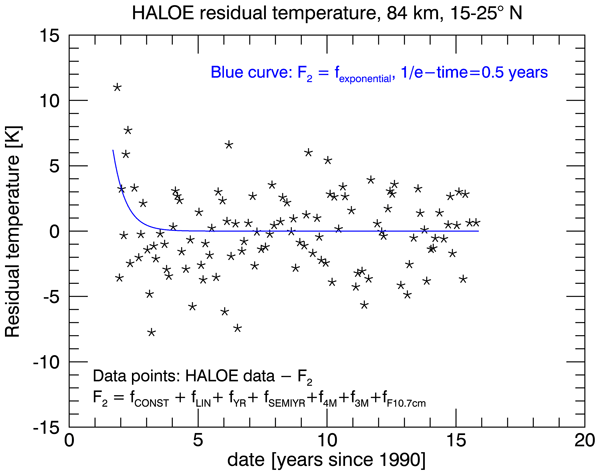
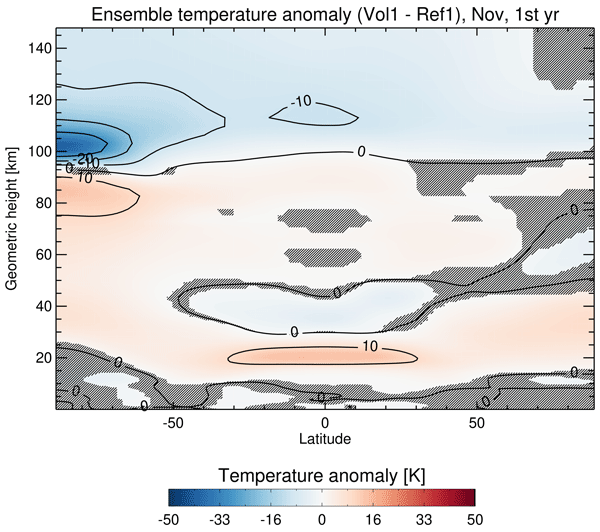
VolDyn focussed on the dynamical effects of volcanic eruptions on the atmosphere, especially the mesosphere (50 - 100 km altitude). The main results of VolDyn are:
- The HALOE satellite instrument potentially captured the declining warming signal of the mesosphere after the massive 1991 Pinatubo eruption (Wallis et al., 2022)
- Model simulations indicate that such a temperature signal might be due to vertical coupling effects by gravity waves caused by zonal wind changes induced by the aerosol heating in the lower stratosphere (Wallis et al., 2023)
- The phreatomagmatic 2022 Hunga eruption emitted large amounts of water vapour into the middle atmosphere that was detected by satellite instruments in the summer mesopause region approximately two years after the eruption (Wallis et al., 2025)
Furthermore, we were studying why volcanic aerosol forcing seems to be less effective than greenhouse gas forcing in causing global mean surface temperature changes.
- Günther et al. (2022) show that this is due to a pattern effect. Stratospheric volcanic aerosols cause a temperature response that is stronger in the Pacific warm pool area than the response caused by CO2 forcing. This leads to differences in the global climate feedbacks caused by the forcings and finally different global mean temperature effects.
- The cause for the difference of the temperature pattern responses was discussed by Günther et al. (2024). They argue that this is related to different stratospheric circulation responses to the forcing.
Wallis, S., Hoffmann, C. G., and von Savigny, C.: Estimating the impact of the 1991 Pinatubo eruption on mesospheric temperature by analyzing HALOE (UARS) temperature data, Ann. Geophys.,40, 421–431, https://doi.org/10.5194/angeo-40-421-2022, 2022.
Wallis, S., Schmidt, H., and von Savigny, C.: Impact of a strong volcanic eruption on the summer middle atmosphere in UA-ICON simulations, Atmos. Chem. Phys., 23, 7001–7014, Research Highlight, https://doi.org/10.5194/acp-23-7001-2023, 2023.
Wallis, S., DeLand, M., and von Savigny, C.: Did the 2022 Hunga eruption impact the noctilucent cloud season in 2023/24 and 2024?, Atmos. Chem. Phys., 25, 3635–3645, https://doi.org/10.5194/acp-25-3635-2025, 2025.
Günther, M., H. Schmidt, C. Timmreck & M. Toohey: Climate feedback to stratospheric aerosol forcing: the key role of the pattern effect, Journal of Climate, 35, 4303-4317, 2022.
Günther, M., H. Schmidt, C. Timmreck, & M. Toohey: Why does stratospheric aerosol forcing strongly cool the warm pool?, Atmospheric Chemistry and Physics, 24, 7203–7225, 2024.
VolClim
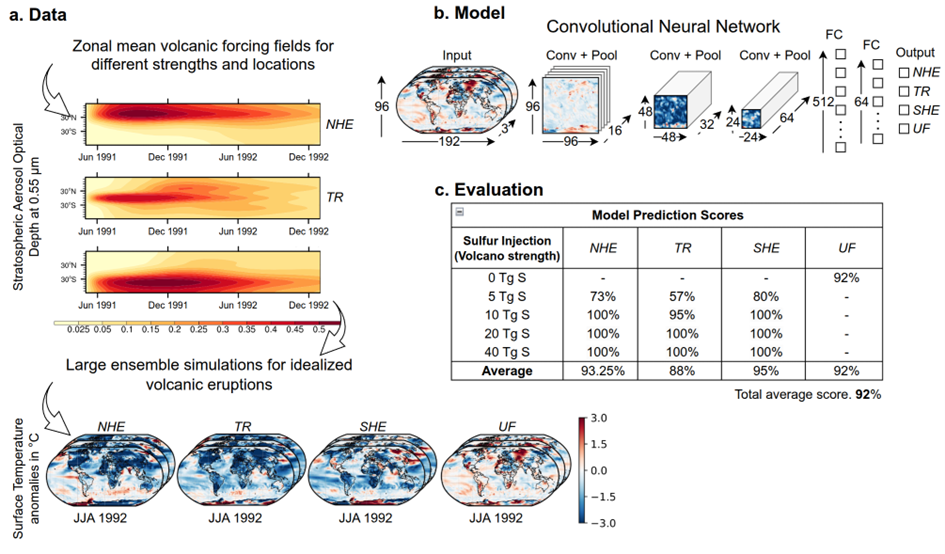
The goal of VolClim was to investigate the volcanic impacts on climate — in particular, the tropical hydroclimate and winter circulation in the Northern Hemisphere — and to use innovative AI/ML techniques to take the predictability of volcanic climate change to a new level. Our key results are as follows:
Volcanic fingerprints Global and hemispheric mean anomalies in near-surface temperature and precipitation scale linearly with emission magnitudes, provided that the volcanic forcing pattern is similar and the sulfur emissions are between 10 and 40 Tg. Based on these findings a data-driven methodology has been developed that uses seasonal mean anomalies of near-surface temperature in reanalysis data and proxy reconstructions to determine whether and where a volcanic eruption occurred.
Ensemble generation. We have developed a novel deep-learning framework that efficiently generates climate simulation ensembles by combining a variational autoencoder for dimensionality reduction with a denoising diffusion probabilistic model based on a spatio-temporal transformer architecture.
Moisture fluxes into the stratosphere. Stratospheric water vapor increases proportionally to volcanic warming and mean cold-point temperatures, while maintaining a constant 80% vapor to 20% ice moisture split even during strong thermal perturbations. Overshooting convection driven by the cold point serves as the primary transport mechanism for ice into the tropical tropopause region.
Tropical hydroclimate Monsoons are generally weakened for two years, depending on the eruption strength and accompanied by a weakening of the regional tropical circulation, a shrinking of the Hadley Cell's ascent and a narrowing of the Intertropical Convergence Zone.
Northern Hemisphere winter circulation Stratospheric volcanic aerosols induce zonal anomalies in near-surface temperatures during the Northern Hemisphere winter through two distinct and independent mechanisms. The longwave‐induced anomalies are primarily related to altered stratospheric winds and the shortwave‐induced anomalies cause a Rossby wave train potentially related to tropical convection.
Andreasen, L. S., Shaw, T. A., Günther, M., and Timmreck, C.: Independent Short- and Longwave Pathways for a zonally asymmetric Northern Hemisphere Temperature Response to Tropical Volcanic, Geophys. Res. Lett., 53, e2025GL117680, https://doi.org/10.1029/2025GL117680, 2026.
D'Agostino, R. and Timmreck, C.: Sensitivity of regional monsoons to idealised equatorial volcanic eruption of different sulfur emission strengths, Environ. Res. Lett., 17, 054001, https://doi.org/10.1088/1748-9326/ac62af, 2022.
Kroll, C. A., Dacie, S., Azoulay, A., Schmidt, H., and Timmreck, C.: The impact of volcanic eruptions of different magnitude on stratospheric water vapor in the tropics, Atmos. Chem. Phys., 21, 6565–6591, doi.org/10.5194/acp-21-6565-2021, 2021.
Kroll, C. A., Fueglistaler, S., Schmidt, H., Dauhut, T., and Timmreck, C.: The impact of stratospheric aerosol heating on the frozen hydrometeor transport pathways in the tropical tropopause layer, Environ. Res. Lett., 19, 044039, https://doi.org/10.1088/1748-9326/ad33d0, 2024.
Meuer, J., Witte, M., Plésiat, É., Ludwig, T., and Kadow, C.: Field-space autoencoder for scalable climate emulators, npj Artif. Intell., 2, 50, https://doi.org/10.1038/s44387-026-00116-z, 2026.
Meuer, J., Witte, M., Finn, T. S., Timmreck, C., Ludwig, T., and Kadow, C.: Latent Diffusion and Spatiotemporal Transformers Generate Large Ensemble Climate Simulations, IEEE T. Artif. Intell., 7, 2625–2637, https://doi.org/10.1109/TAI.2025.3621121, 2026.
Meuer, J., Timmreck, C., Fang, S.-W., and Kadow, C.: Fingerprints of past volcanic eruptions can be detected in historical climate records using machine learning, Commun. Earth Environ., 5, 455, https://doi.org/10.1038/s43247-024-01617-y, 2024.
Timmreck, C., Olonscheck, D., Ballinger, A., d’Agostino, R., Fang, S.-W., Schurer, A. P., and Hegerl, G. C.: Linearity of the climate response to increasingly strong tropical volcanic eruptions in a large ensemble framework, J. Climate, 37, 2455–2470, https://doi.org/10.1175/JCLI-D-23-0408.1, 2024.