
The PIRATE collaborative project addresses fundamental knowledge gaps in the pathophysiology and diagnostics of intracranial aneurysms. The following project description details the initial clinical situation as well as the use of innovative in-vivo methods for developing personalized therapy planning.
The project ("Personalized Intracranial Risk Assessment of Aneurysm Patients for Therapy Evaluation") consists of an interdisciplinary team that uses state-of-the-art medical imaging, analytical, and computer-assisted methods to create individualized prognoses for patients with cerebral aneurysms.
Cerebral aneurysms are a neurovascular condition whose treatment depends significantly on medical expertise and the specific characteristics of the aneurysm. A rupture often leads to hemorrhage with high mortality and morbidity rates. Since current diagnostic methods rely on simplified models, they frequently prove insufficient; the risk of aneurysm growth or rupture, as well as the associated mortality and long-term consequences, are currently difficult to assess. To help patients more effectively, the primary goal of the project is to develop a prototype software as a decision support tool for physicians, which determines the optimal treatment strategy tailored to each individual patient.
The project is divided into three subprojects, each designed to foster close collaboration among various team members within the consortium:
Subproject 1:
Focuses on image-based risk stratification, tissue extraction, and treatment methods for intracranial aneurysms. This includes novel imaging methods, retrospective and prospective analyses of treatments, and the validation of new evaluation platforms. In this context, in vitro biomarkers for early diagnosis will be analyzed, and imaging findings will be correlated with tissue examinations.
Subproject 2:
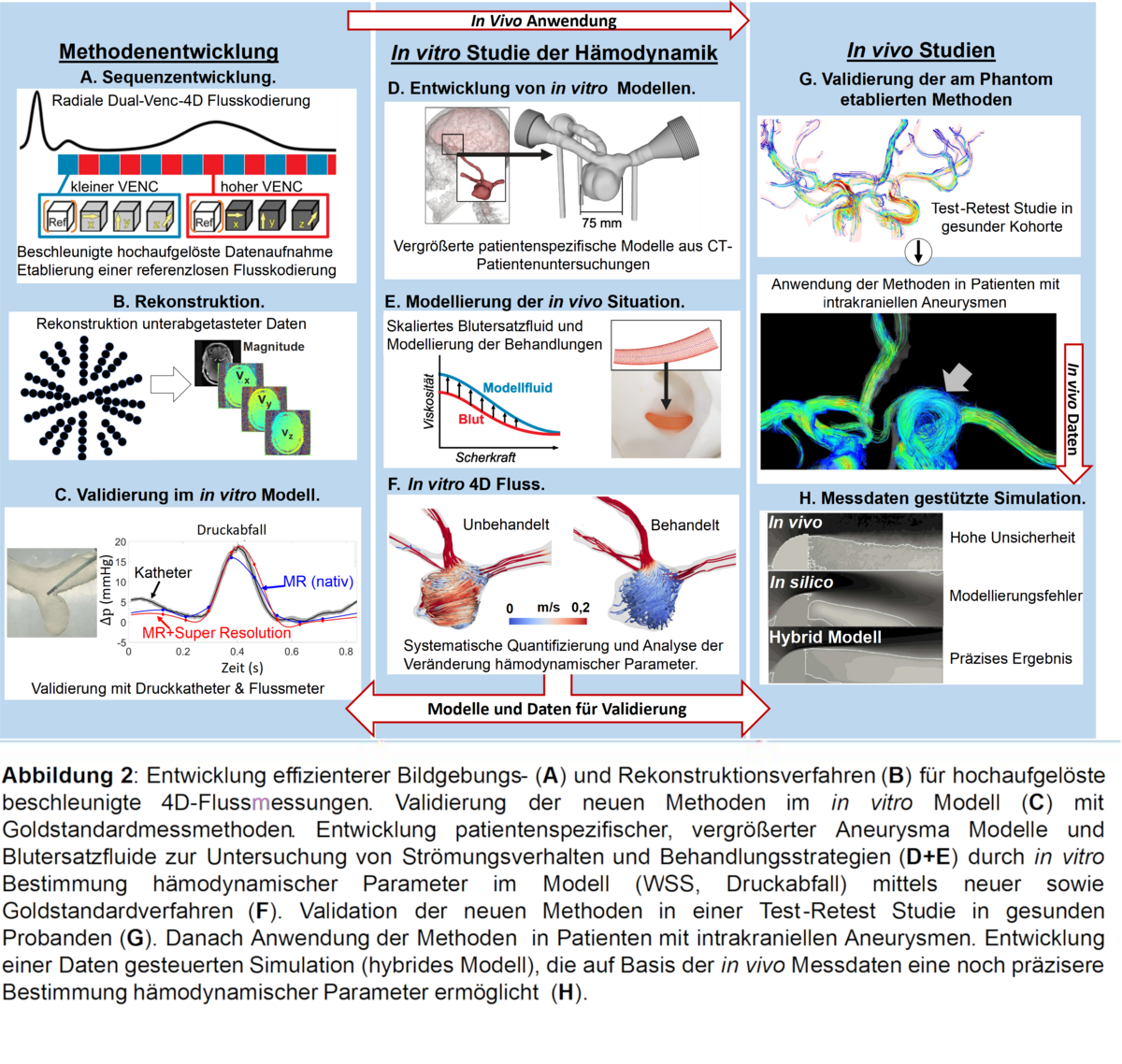
This subproject focuses on the development of more efficient magnetic resonance imaging (MRI) methods for flow imaging, as well as enhancing data accuracy through fluid mechanics methods. Additionally, patient-specific replicas of cerebral aneurysms are utilized for method validation and hemodynamic analysis in patients who cannot undergo MRI examinations.
Subproject 3:

Focuses on the evaluation of MRI data based on artificial intelligence to determine hemodynamic and arterial geometric metrics. Combined with clinical patient data, these data are used to develop a prognostic model to predict growth or rupture in future aneurysm patients.