
Tiano left the group
06/30/2026
Sebastian “Tiano” Haag has been a technician in our research group since May 2022. He played a key role in the reconstruction and recommissioning of the VINETA experiment. He has supported us with all our work in the laboratory. Particularly noteworthy is the development and construction of a control cabinet for our planned small tokamak experiment and the axial movement unit for VINETA. He has done a truly outstanding job. We will miss him very much. All the best.
Mini-stellarator at Science Day in Greifswald
06/27/2026
At Science Day, Peter Manz, Franz Bronold and Sebastian Haag demonstrated how extremely hot gas (plasma) can be confined without contact by complex magnetic fields. The mini-stellarator makes the fundamentals of magnetic plasma confinement tangible for young and old alike. Unlike its larger counterpart, the Wendelstein 7-X, the mini-stellarator is designed to be handled directly. Science Day was a resounding success for us. We were delighted to welcome everyone who visited us on Saturday.
The mini-stellarator was developed and built at the IPP; we would like to thank the IPP for the donation.
Peter Manz gives a presentation at the RIAM Forum
06/26/2026
At the RIAM Forum, Peter Manz presented our study on the transition into turbulence.
Turbulence is one of the most fundamental and challenging phenomena in fluid and plasma physics. In magnetically confined plasmas, turbulence is responsible for strong particle and heat transport and therefore plays an important role for fusion research. While fully developed turbulence has been studied extensively, considerably less is known about transitional regimes between ordered wave dynamics and broadband turbulence. Similar questions also arise in neutral-fluid flows, where localized turbulent structures, known as puffs and slugs, appear close to the transition to turbulence in pipe flows.
In this work, we investigate transitional drift-wave turbulence in the linear magnetized plasma experiment PANTA. Drift waves are among the most fundamental plasma instabilities and provide a comparatively simple system for studying the onset of turbulent behavior in magnetized plasmas. By varying the magnetic-field strength, the plasma dynamics change from relatively coherent wave motion to increasingly irregular turbulent states.
The experiments reveal the appearance of long-lived coherent structures that show remarkable similarities to puffs and slugs known from transitional pipe flows. Using conditional-averaging techniques, the temporal evolution of these structures can be followed over long timescales. Near the transitional regime, the structures persist much longer than expected from conventional local correlation measurements. Small changes of magnetic-field strength lead to strong changes in the correlation times and correlation lengths, indicating the existence of a critical point associated with a nonequilibrium phase transition.
Different dynamical behaviors are observed depending on the magnetic-field strength. At lower magnetic field, coherent structures occasionally split into smaller daughter structures in a process similar to puff splitting in pipe flows. At intermediate magnetic field, expanding coherent structures resembling slugs are observed, followed by the formation of gaps that separate the structures into multiple parts. At higher magnetic field, several coherent structures coexist and interact strongly with each other, leading to a behavior comparable to puff jamming. In this regime, the interaction between structures shortens their lifetime and enhances the transition toward broadband turbulence.
The results demonstrate that important concepts from transitional turbulence in neutral fluids can also appear in magnetized plasmas despite the very different physical environments. In particular, the experiments suggest that transitional drift-wave turbulence may be governed by universal mechanisms related to self-sustained turbulence and nonequilibrium phase transitions. These findings open new perspectives for understanding the emergence and regulation of turbulence in plasmas and may contribute to a deeper connection between plasma physics and modern fluid dynamics.
This study has been published in Phys. Rev. E.
DYNAFLUC kickoff meeting
On 19 and 20 May, we held the kick-off meeting for the DYNAFLUC project in Paris. The project brings together many researchers with diverse areas of expertise and perspectives. Peter Manz and Sander De Koker presented their joint project. There were many interesting discussions. We would like to thank Laure Vermare for organising the event.
Peter Manz gives lecture at PSI conference
05/17/2026
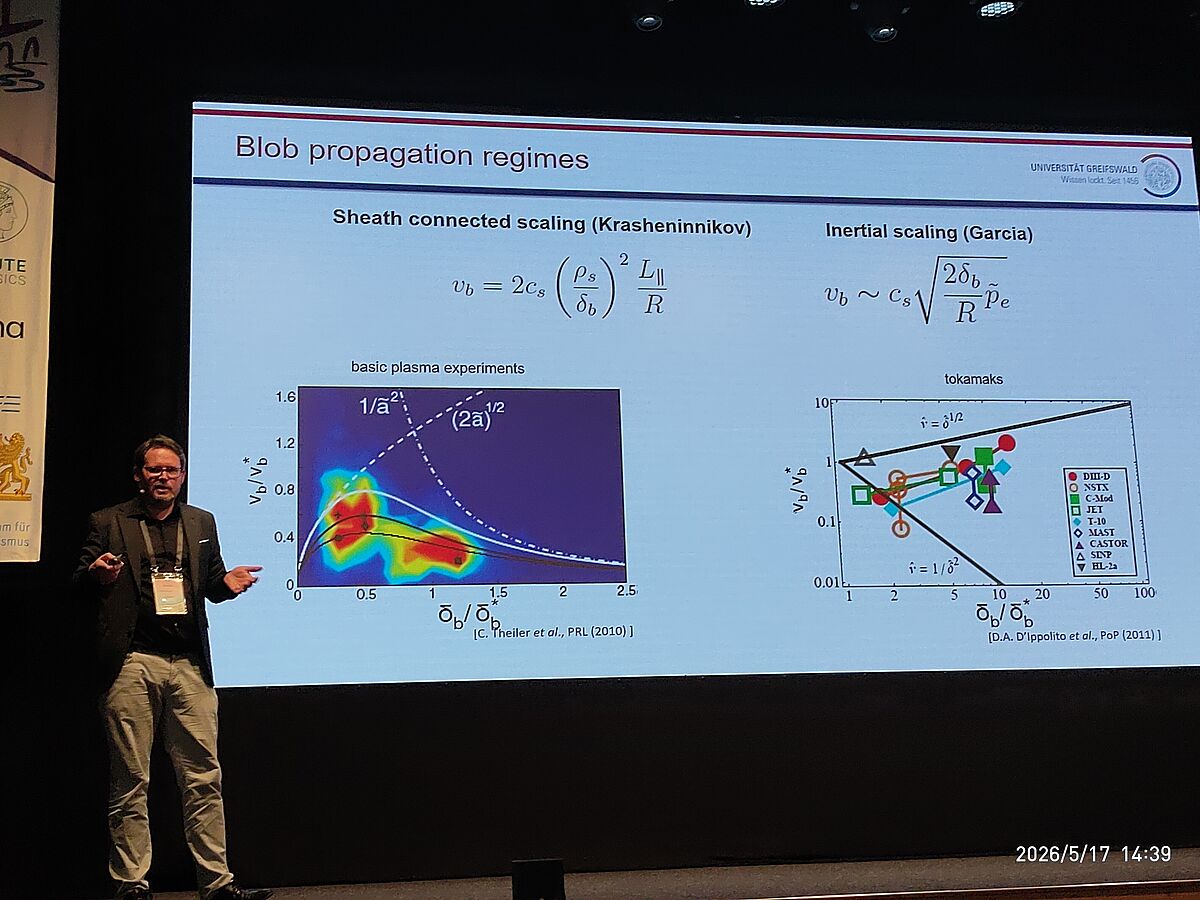
It is a great honour for Peter Manz to deliver an invited lecture on turbulent transport in scrape-off layers at the start of the 27th International Conference on Plasma-Surface Interactions in Controlled Fusion Devices (PSI) in Regensburg.
Peter Manz at the 2026 Sherwood Fusion Theory Conference
04/27/2026
Peter Manz will give a talk at the Sherwood Fusion Theory Conference on the Separatrix Operational Space (SepOS) concept.
new thermographic inversion code developed
04/08/2026
Up to now, the explicit thermographic inversion code THEODOR has been used to calculate the heat flux distribution on plasma-facing components from the evolution of surface temperature derived from infrared camera measurements. However, due to the missing capability of defining multiple material layers, THEODOR cannot be used for the water-cooled high-heat flux divertors of W7-X made of layers of different materials. To this end, Sebastian Thiede developed the code DELVER (Divertor Energy Load Versatile EstimatoR). DELVER improves upon explicit THEODOR in further aspects by handling 1D, 2D, and 3D modeling with flexible boundary conditions, an implicit solver, arbitrary functional temperature dependency of the orthotropic thermal properties of the materials, and a non-equidistant orthogonal calculation grid. The results have now been published in Rev. Sci. Instrum.
Andre Elvers submited his Bachelor's Thesis
04/07/2026
In his bachelor's thesis, Andre Elvers, together with Sebastian Haag, developed and built the axial positioning system for VINETA.75. The axial positioning system is of particular importance to the HELIKWAKE project.
Using this system, he investigated how the axial profiles behave in terms of density and temperature in the VINETA.75 and whether plasma detachment occurs. We thank Mr. Elvers for his excellent work.
Horst Holger Boltz is joining our working group
03/26/2026
We are delighted to have been able to secure Dr. Horst Holger Boltz at such short notice as the successor to Dr. Stefan Knauer for the PlaCOs project. With his experience in interdisciplinary research and his specialist knowledge of non-equilibrium dynamics, he is a tremendous asset to the PlaCOs project.
Stefan Knauer is leaving physics
03/09/2026
Dr Stefan Knauer is taking on new professional challenges and switching from physics to psychology. Stefan Knauer joined our research group in October 2021. With Stefan’s departure, we are losing an experienced experimental physicist. He has made a significant contribution to our development as a group. He played a key role in the reconstruction of VINETA, where he particularly excelled in the control of the heating system and diagnostics. Stefan also set up the SEAGULL experiment largely on his own. Nor would we have been able to commission SWADEX-II without him. In particular, the study on Keplerian rotation in SWADEX-II, conducted under his leadership, was a major success for the research group. He was a key pillar of support in supervising students. We would like to thank Stefan for his outstanding work and dedication over the past years and wish him every happiness and success in his new career.
Johannes Condoi submitted his bachelor's thesis
03/08/2026
In his bachelor’s thesis, Johannes Condoi investigated the electromagnetic radio-frequency field in capacitively and inductively coupled plasmas using B-dot probes. Whilst in capacitive coupling mode the RF wave propagates through the plasma, in inductive coupling mode an azimuthal plasma current forms near the antenna, thereby heating the plasma.
The B-Dot probes have been successfully tested and can be used in the VINETA.75. These are required for the HELIWAKE project.
Johannes Condoi is leaving our research group to join our partner at Kyushu University in Japan. We would like to thank him for his excellent work, wish him every success there, and look forward to a fruitful collaboration.
PhD defence TUM
03/03/2026
Peter Manz was on the jury for Kaiyu Zhang’s PhD defence. Congratulations to Dr Zhang on successfully defending his excellent thesis. Dr Zhang has succeeded in enabling global electrodynamic simulations for the edge region of tokamaks in realistic geometries. We are sure to hear a lot more from him in the future.
Transition from drift wave turbulence (DW) to kinetic ballooning turbulence (KBM) triggers pedestal buildup
02/19/2026
An abrupt transition from drift-wave turbulence (DW) to kinetic ballooning turbulence (KBM) can trigger a pedestal buildup within a short time typical for L-H transitions. This has been shown in global full-f turbulence simulation with the GRILLIX code. The study let by Wladimir Zholobenko from the Max-Planck-Institute for Plasma Physics (IPP) in Garching has been recently published in Physical Review Letters.
Seminar at the Institute of Solar-Terrestrial Physics at DLR
02/05/2026
Peter Manz presents the activities of the working group at the seminar held by the Institute of Solar-Terrestrial Physics at the German Aerospace Center (DLR) in Neustrelitz.
New winter additions to the working group
02/2026
We are also taking advantage of the winter transfer window to strengthen our team. The working group welcomes three new members in February:
Dr. Gennadii Liziakin comes from the Technion, Israel Institute of Technology, in Haifa. He is a proven expert in mass separation in magnetized plasmas and already has experience with helicon discharges. He will strengthen our experimental team at VINETA.75.
Dr. Maurice Mauer originally comes from fusion research and has extensive expertise in gyrokinetic plasma physics, numerical simulation of magnetized plasmas, and high-performance computing. In recent years, he has offered Python courses for scientists and engineers at graduate schools of the Max Planck Institutes and universities. With Mr. Maurer's help, we can now numerically accompany our experiments.
Sander De Koker recently completed his master's degree in nuclear fusion and engineering physics at the University of Aix-Marseille as part of the Fusion-EP program. In his master's thesis, Mr. De Koker investigated the sensitivity of poloidal correlation reflectometry (PCR) using full-wave simulations in Stuttgart. As part of the DYNAFLUC project, he will investigate phase velocities with PCR at W7-X.
Stefan Knauer and Stefan Schütt present SWADEX-II in Heidelberg
01/27-30/2026
Stefan Knauer and Stefan Schütt are in Heidelberg this week, discussing future collaborations with the Max Planck Institute for Astronomy and presenting our SWADEX-II experiment there.
Guests from Fukuoka, Japan
01/20-23/2026
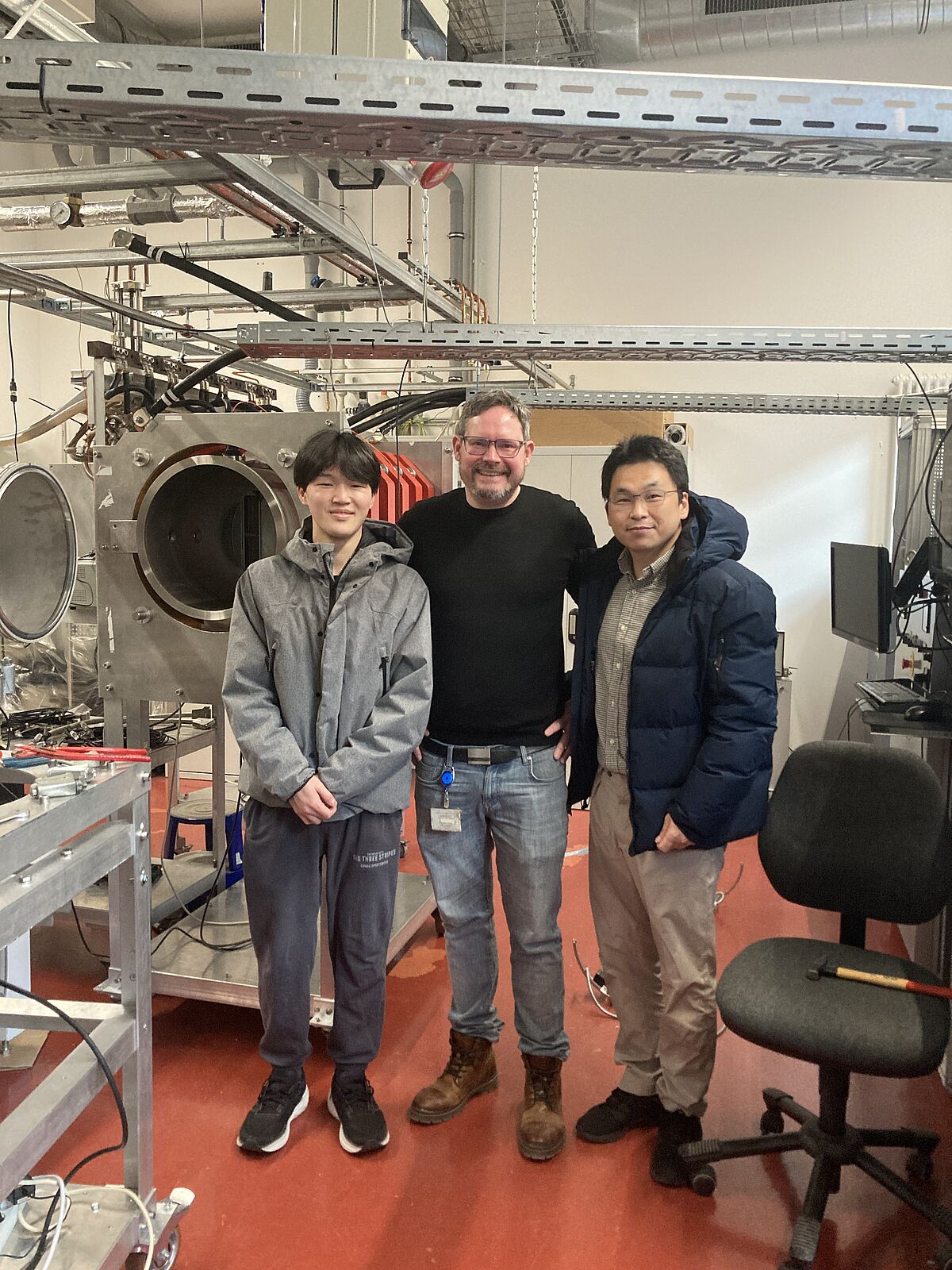
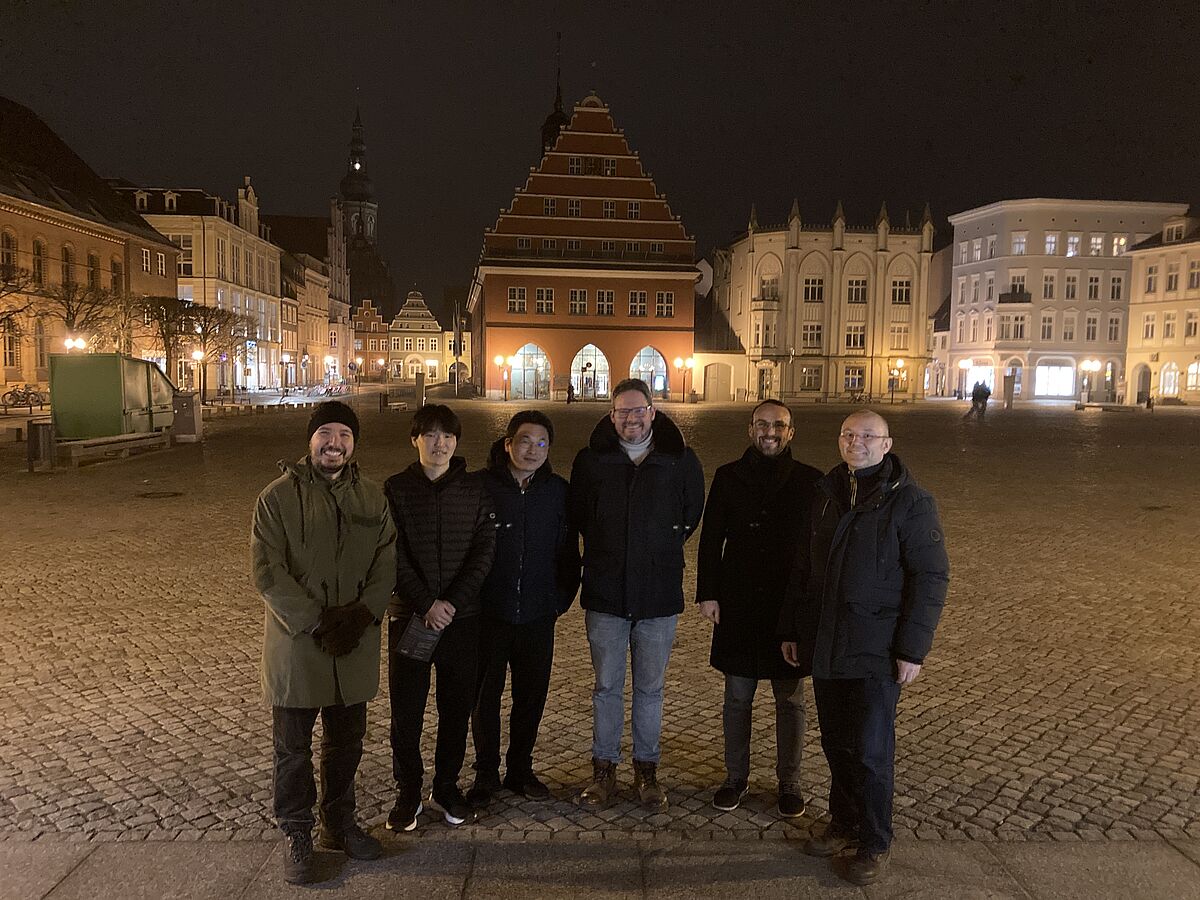
We have a close collaboration for several years with the research group of Prof. Dr. Moon from Kyushu University in Fukuoka. Prof. Dr. Chanho Moon and Takamasa Ogata recently visited us in Greifswald to discuss our joint research projects.
Felix Schuchmann submitted his bachelor's thesis
01/12/2026
Felix Schuchmann submitted his bachelor's thesis on the topic of “Decoupling particle and heat transport in drift-wave turbulence by conduction.” The thesis is based on the idea that fluctuations in electron temperature can be dissipated through heat conduction, which can lead to a decoupling of particle and heat transport. This is particularly relevant for the I-mode. In his thesis, Mr. Schuchmann performed simulations of an extended Hasegawa-Wakatani system using BOUT++. He was supported in this by T. Tork (IPP), T. Gherorghiu, and R. Ghian (both University of York). It has been shown that temperature fluctuations can lead to an anti-correlation between potential and density fluctuations, which can also lead to an anti-correlation of particle and heat transport. We would like to thank Mr. Schuchmann for his excellent work.